
A Negative Legionella Test Does Not Guarantee a Safe Water System
Legionella Risk Management
Published
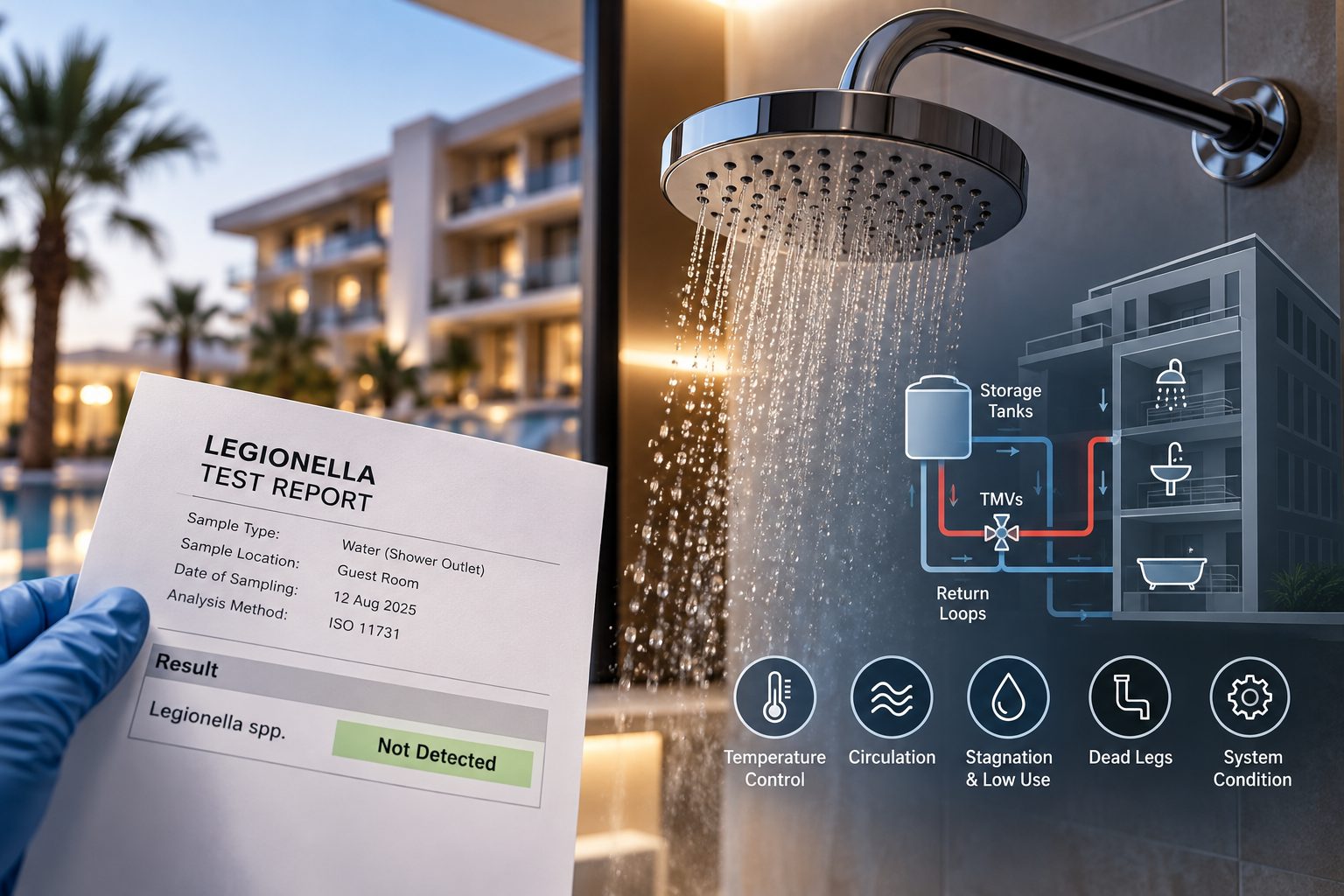
A hotel received a Legionella test report. The results are negative.
That is good news, but it is not the same as saying that the water system is safe.
Water systems in hotels can include storage tanks, hot water return loops, hundreds of outlets, showers, TMVs, and areas that are rarely used. The result of a laboratory test tells us something about the sample. Risk assessments focus on a broader question: what is happening in the water system, and are the controls working?
A single sample represents only one point in time
When necessary, Legionella sampling can be useful. In HSE guidance, microbiological monitoring of hot and cold-water systems is not normally required but may be appropriate when control parameters are not consistently achieved or when there is doubt about the effectiveness of the control regime.
The result of a sample from a single guest room outlet should be considered alongside the condition of the system, temperature records, circulation, and other available data. It should not be treated as a certificate saying that the whole hotel is free from Legionella risk.
The system can change after a sample is taken
In hotels, this is particularly important. Rooms may remain empty for a long time. There may be a section of pipe that is no longer in use. Maintenance work may change the way the water circulates. A TMV may be replaced. A problem with the return loop may develop.
None of these changes will appear on an old laboratory report. This is why the physical water system needs attention. HSE guidance for large buildings such as hotels specifically highlights the need to understand the design and operation of the hot and cold water system, including dead legs, TMVs, sentinel outlets and other components.
What matters in a hotel water system?
There is no single measurement that tells the whole story. Temperature is an important control parameter. So are circulation, storage, stagnation, system cleanliness and the condition of the pipework.
Low-use outlets deserve particular attention, as do parts of the system where temperatures are not consistently controlled. These are the kinds of issues that a risk assessment can identify even when recent laboratory results are satisfactory. HSG274 specifically identifies low usage, stagnation, dead legs and areas where control parameters are not being achieved as circumstances that may warrant sampling and further investigation.
Testing and risk assessment have different jobs
It is useful to keep the distinction simple:
- A test tells you what was found in a particular sample.
- A risk assessment looks at why the system may or may not allow the risk to develop, and whether the controls are appropriate and working.
One does not replace the other.
For a hotel, the practical objective is not simply to obtain a negative Legionella result. It is to have a water system that is understood, controlled and maintained, with problems identified before they become a larger issue. That is where a proper assessment adds value.